Classical Voice in Musical Theater & Concert Bachelor
Course content
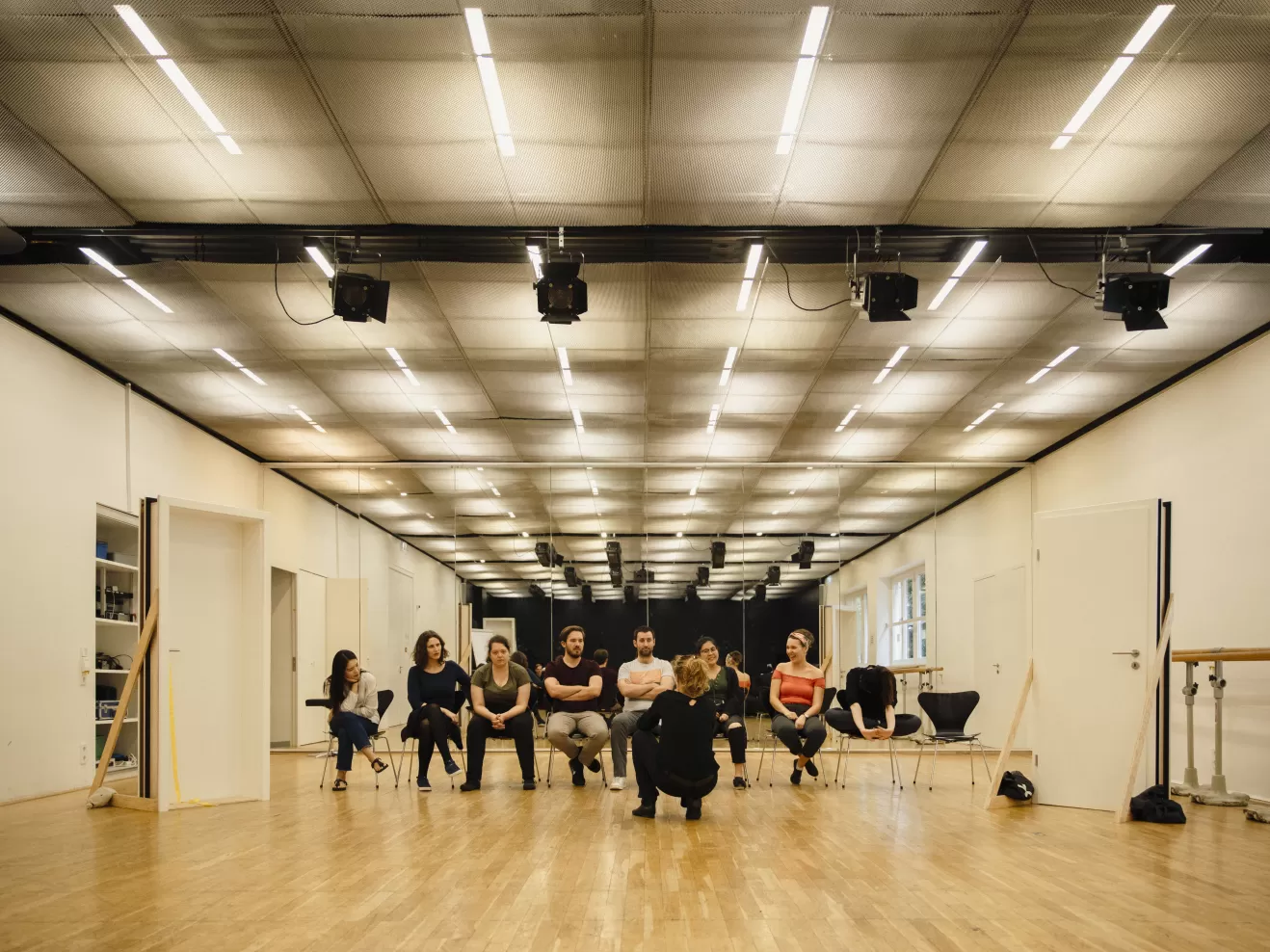
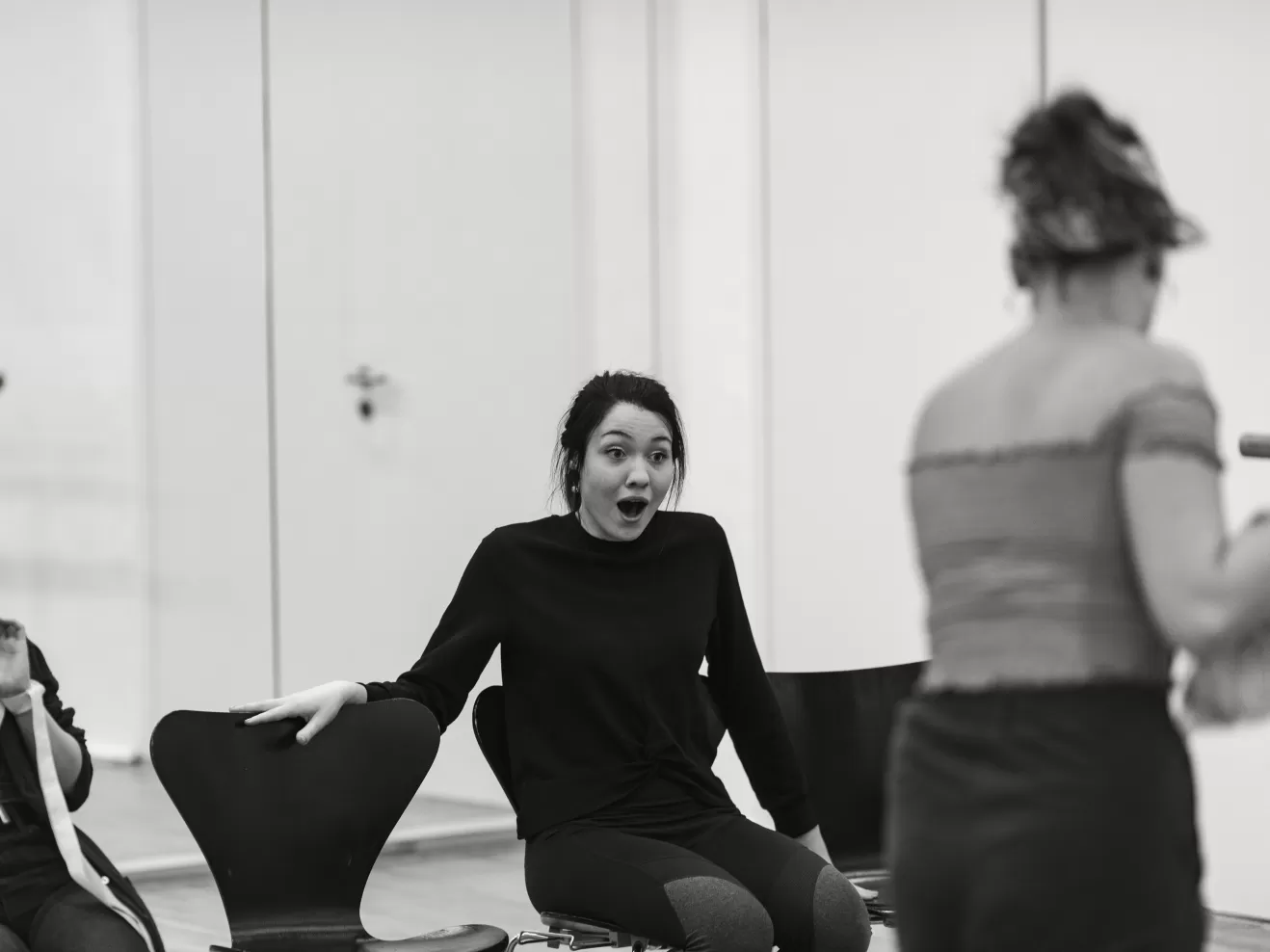
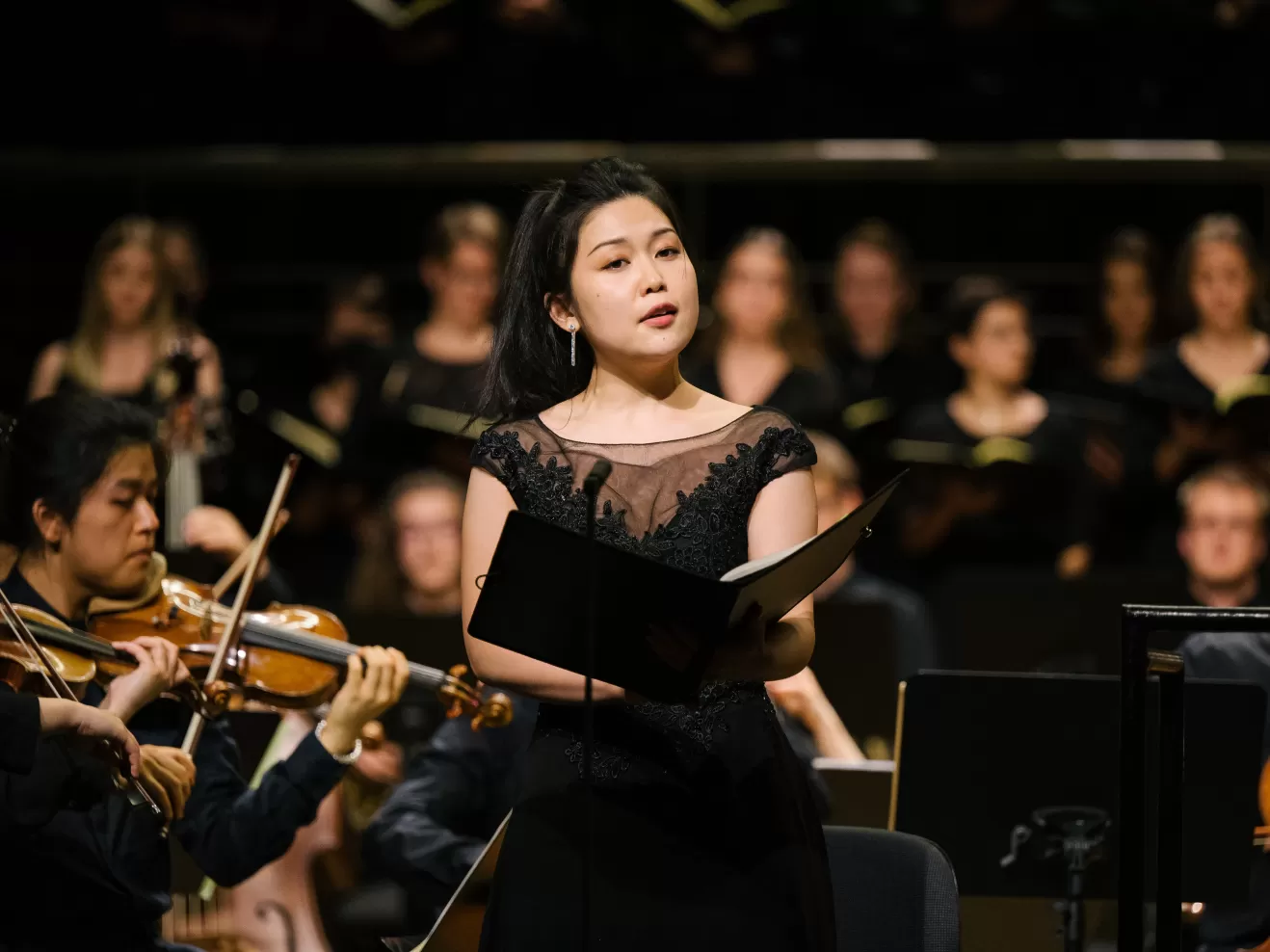
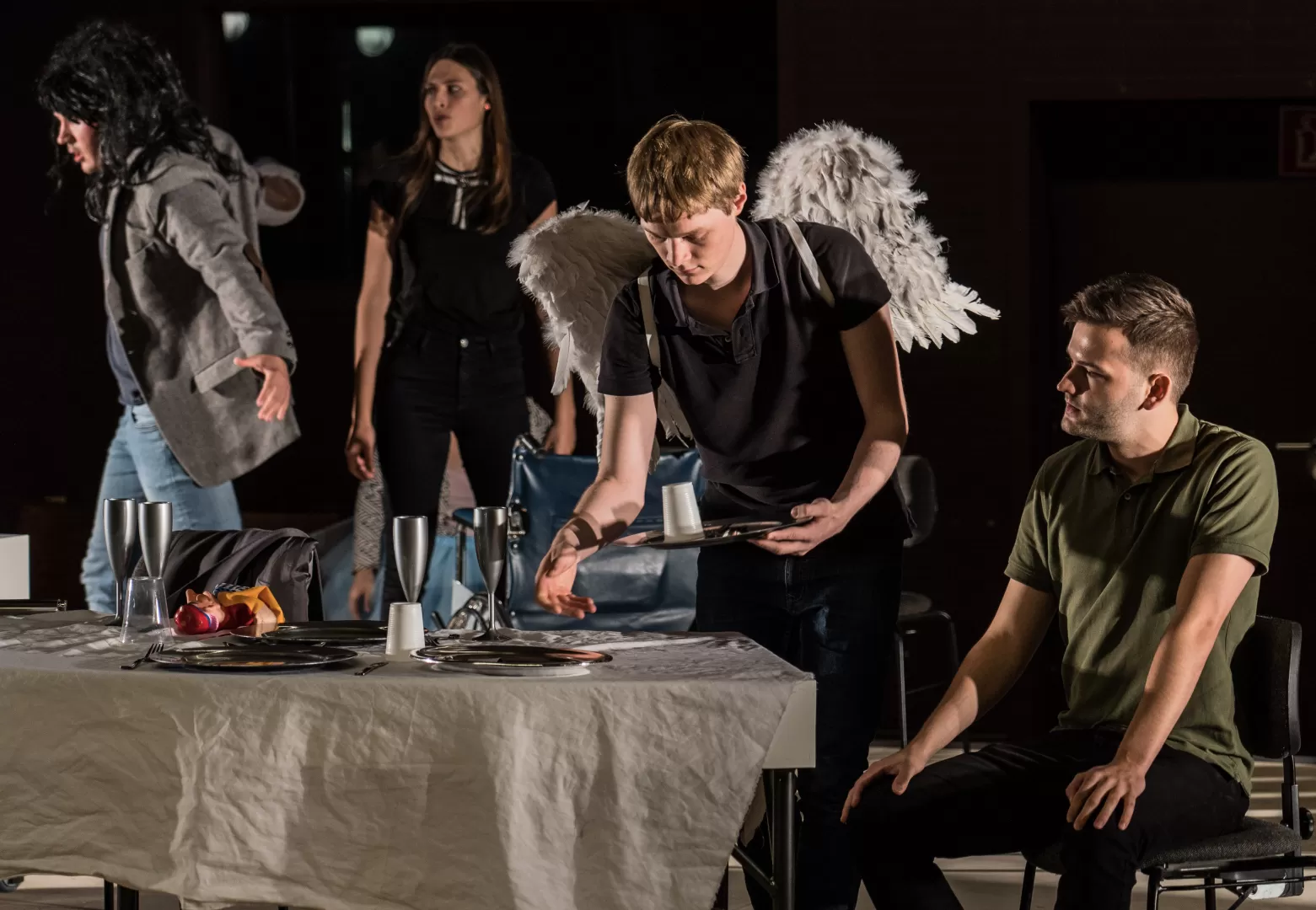
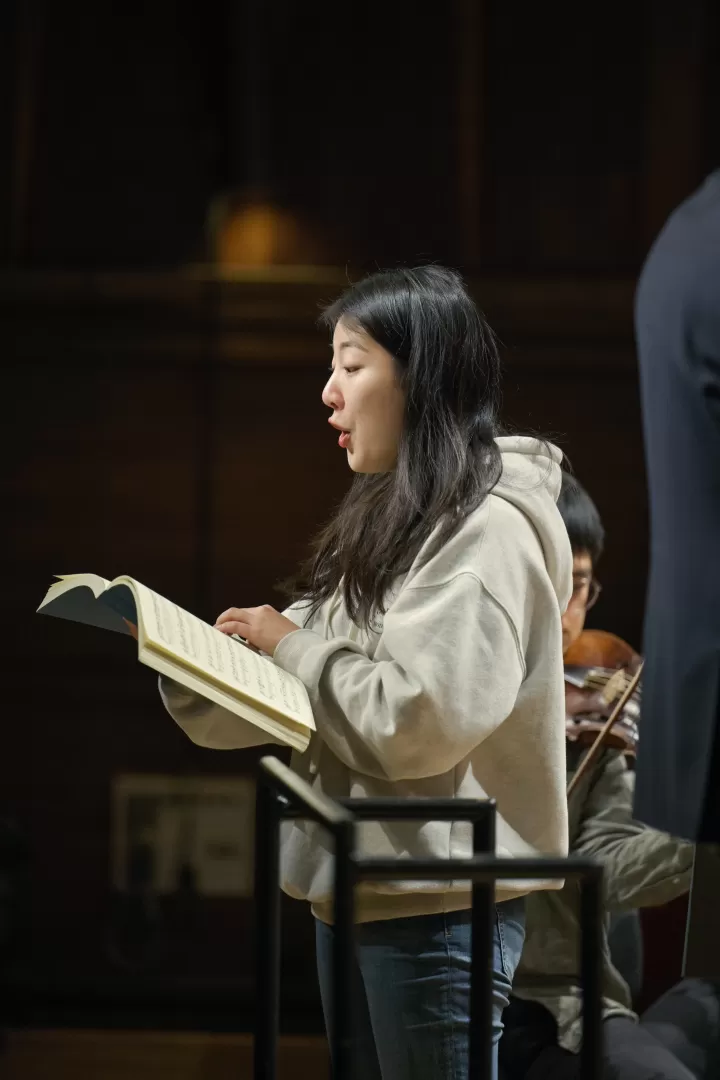
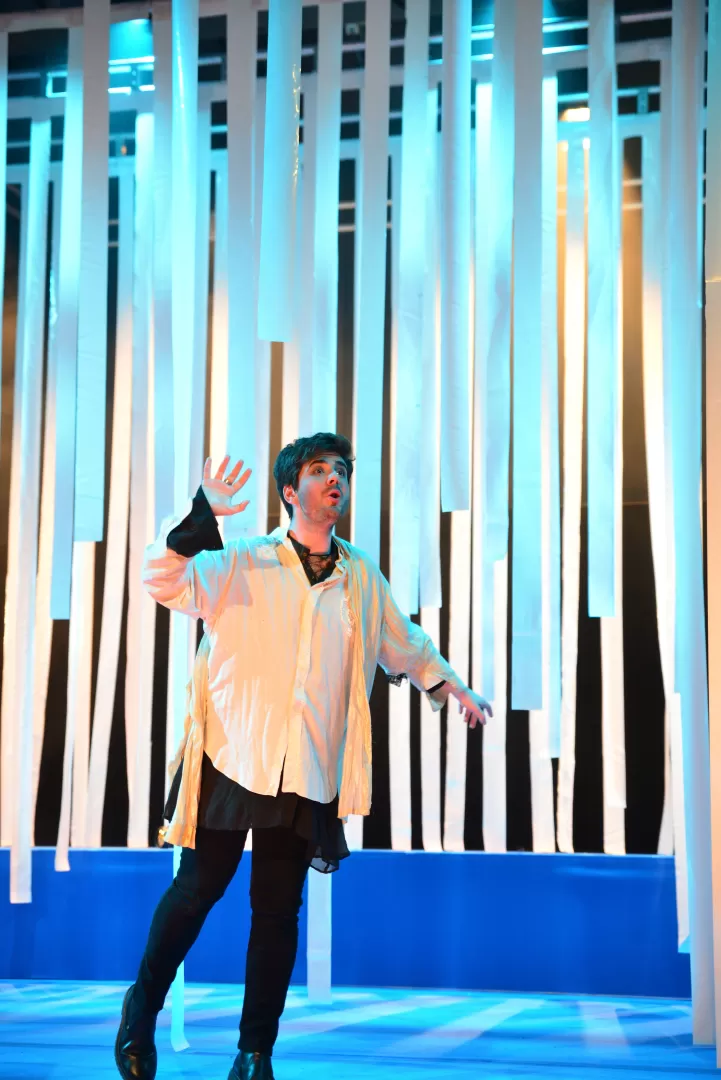
The bachelor's programme leads to a first university degree. The aim is the basic training of singers who acquire the solid foundations of singing technique during the bachelor's programme and consolidate these musically. Students acquire the basic technical tools for the healthy handling of their own singing voice, fundamental knowledge and skills for an appropriate interpretation of different styles, basic scenic skills, skills in different areas of movement, stage presence as well as a reflected handling of the repertoire appropriate to their own voice.
Vocal Pedagogy, Music Theory, Diction
In addition, students receive knowledge of the basics of vocal pedagogy as well as a broad basic knowledge of music theory and musicology, knowledge of piano playing, good Italian language skills and the basics of English and French diction.
In 2011, the HfMDK's vocal department was awarded the Hessian Excellence Prize for university teaching.
Dates & Deadlines
Aptitude tests for winter semester 2025/2026*
*You will receive details of your aptitude test dates with your invitation approx. 3 to 4 weeks before your aptitude test appointment.
Requirements
The prerequisite for admission to the bachelor's degree program in voice is proof of the university entrance qualification (Abitur) according to § 54 para. 2 of the Hessian Higher Education Act of 14.12.2009 in the version of 21 December 2010. A missing university entrance qualification can be replaced by an outstanding artistic talent (at least 19 out of a possible 25 points in the aptitude test) according to § 54 para. 4 sentence 3 HHG.
Sufficient oral and written knowledge of German (for non-native speakers B1) is required for admission to the bachelor's degree programme in singing; a phoniatric certificate ENT is also required. Admission to the Bachelor's degree programme in Voice requires the successful completion of an aptitude test.
ENT / Otorhinolaryngology report
- The ENT report must be issued by a specialist in phoniatrics and demonstrate the vocal physiological suitability for a singing course.
- The ENT report may not be older than six months at the time of application.
- If you are unable to submit the ENT report by 1 April, you must submit it by mail by 15 June.
- Foreign certificates are also accepted, provided you enclose a translation into German.
- If the circumstances require we might ask you to hand an phoniatric report in later.
Application
What do I need for the application?
Language Certificates
Here you will find a list of required German and/or English language skills for all degree programs. Please check which of these requirements apply to your degree program.
Digital preselection
A digital preselection according to §11 Eignungsprüfungsordnung is part of the aptitude test.
For the digital preselection, the following must be submitted as a video as part of the online application:
- Name and self-introduction in a few sentences on the musical career and the motivation for the study of voice.
- Selection of 2 works from the programme to be submitted for the presence aptitude test (see below).
Opera arias and songs must be performed from memory and may be presented with a playback piano accompaniment or without piano accompaniment if no répétiteur is available at the time of the recording.
Please upload your videos to a streaming platform of your choice (e.g. YouTube, Vimeo, Clouds, etc.). The videos must be accessible without a password and streamable without downloading the file.
Please create one video file per work. Submit the links to the videos with your online application.
Aptitude test
We recommend starting under the age of 24 on the Bachelor of Vocal Performance.
The study programme can only be carried out on the basis of good linguistic communication skills, therefore a good knowledge of German is a prerequisite for the study of singing. (A B1 language certificate must be presented.)
The examination takes place in two attendance rounds and can therefore extend over several days. In the first part the main subject singing is examined. Those who pass this part will be admitted to the second part of the examination. This consists of the examinations in listening skills, music theory/musical general knowledge, piano as well as a further examination in the main subject singing.
The examination can therefore extend over several days.
In case of a pre-selection by means of electronic media according to § 11 if passed, the candidate will be invited to the 1st attendance round, which will be carried out unchanged in terms of content on the basis of the fully comprehensive aforementioned programs.
Programme to be submitted
A program of approximately 15 to 20 minutes, consisting of 2 to 3 arias (opera and/or oratorio) and 3 to 4 songs, from different periods and of different character, including at least one work in German and one work in another language, must be submitted. Opera arias and songs have to be performed by heart.
- 1st presence round: performance of a selection of songs and arias (duration approx. 8 minutes), preferably 2 arias (also aria antiche) and 4 songs, corresponding to the applicant's level of training, from different periods and of different character. If the first round is passed, admission to the second round will be granted.
- 2nd presence round: performance of songs and arias from the repertoire not yet heard in the first part (duration approx. 10 minutes).
Aural test
In a written test lasting about 60 minutes, the applicant must demonstrate the ability to recognize elementary rhythmic, melodic, harmonic, tonal and formal relationships by hearing (cf. sample test).
Mustertest Hörfähigkeit B
Für die Bachelorstudiengänge Künstlerische Ausbildung Musik (Instrumentalfächer), Gesang und Komposition.
Lösungen Mustertest Hörfähigkeit B
Für die Bachelorstudiengänge Künstlerische Ausbildung Musik (Instrumentalfächer), Gesang und Komposition.
Music Theory
In a written examination (duration approx. 90 minutes), the following tasks are to be completed:
- Determining and forming intervals and scales (including church scales)
- Determining and forming chords and chord progressions
- Arranging a given melody in two, three or four part harmony
- Comment on a given score excerpt, considering instrumentation, timbre, stylistic/historical classification, form, compositional technique, character
Mustertest Musiktheorie
Für die Bachelorstudiengänge Künstlerische Ausbildung Musik, Kirchenmusik, Komposition und Gesang.
Lösungen Mustertest Musiktheorie
Für die Bachelorstudiengänge Künstlerische Ausbildung Musik, Kirchenmusik, Komposition und Gesang.
Notenbeispiele Musiktheorie
Für die Bachelorstudiengänge Künstlerische Ausbildung Musik, Kirchenmusik, Komposition und Gesang.
Piano
Performing an easy piece (approx. 10 minutes)
Lesefassung: Eignungsprüfungsordnung der HfMDK Frankfurt
[Nicht-amtliche Lesefassung. Stand: 27.10.2025]
Study and Examination regulations
The Study and Examination Regulations (SPO) set out the framework conditions and regulations for your studies. They apply together with the General Regulations (for Bachelor's and Master's degree programmes) or the SPoL (for teacher training degree programmes). All versions of the SPO for your degree programme (including earlier versions for students of previous academic years) can be found at Examinations.
Lesefassung: Allgemeine Bestimmungen für Bachelor- und Masterstudiengänge der HfMDK Frankfurt
Stand: 27.05.2019
Lesefassung: Studien- und Prüfungsordnung für den Bachelorstudiengang Gesang
Diese Fassung gilt
- für alle Studierende mit Studienbeginn ab Wintersemester 2026/27
- für alle Studierende, die nach der SPO vom 15.02.2022 studieren und den Wechsel auf diese Änderung beantragen.
Nicht-amtliche Lesefassung 2022+1Änd26