"Learning the language of jazz"
The HfMDK is launching a degree program with the big band of the Hessischer Rundfunk: the Master Bigband - for players, writers and conductors. It brings instrumentalists, composers, arrangers and conductors together with the musicians of the renowned jazz ensemble. Ralph Abelein talks to Olaf Stötzler, the band's manager, and trumpeter Axel Schlosser about the opportunities offered by this globally unique cooperation.
Interview: Ralph Abelein
»The special thing is that the students have the opportunity to work with us, and we don't just teach in a closet, but pass on our knowledge, our experience directly to them. This has, in a positive sense, something of an apprenticeship on top - in the sense of a craft apprenticeship.«Axel Schlosser, solo trumpeter of the hr-Bigband
Ralph Abelein: The hr-Bigband is no stranger to the university; you have been a welcome guest at the HfMDK Jazzfest for many years. Now, after a two-year conception phase, we are looking forward to starting a new jazz program together with you. Is the hr-Bigband looking forward to it, too?
Olaf Stötzler: Of course. The degree program is the result of a long process, and I have always found our collaboration to be very fruitful and focused. We are glad that Frankfurt is once again getting such a degree program, especially since the cooperation also fits very well with our own goals: As Hessischer Rundfunk, as the sponsor of the hr-Bigband and organizer of the German Jazz Festival, we are committed to this music, to this cultural asset. And as a public broadcaster, we are also committed to an educational mission. Of course, we hope that the cooperation will also help us ourselves - after all, it's about young talent, it's about professionalization in this area. We look forward to discovering and nurturing new talent, and to passing on our knowledge and expertise. In terms of its concept, the course is truly unique.
Ralph Abelein: There are several master's programs for jazz. Axel, what is special about the master's program in big band as we have designed it?
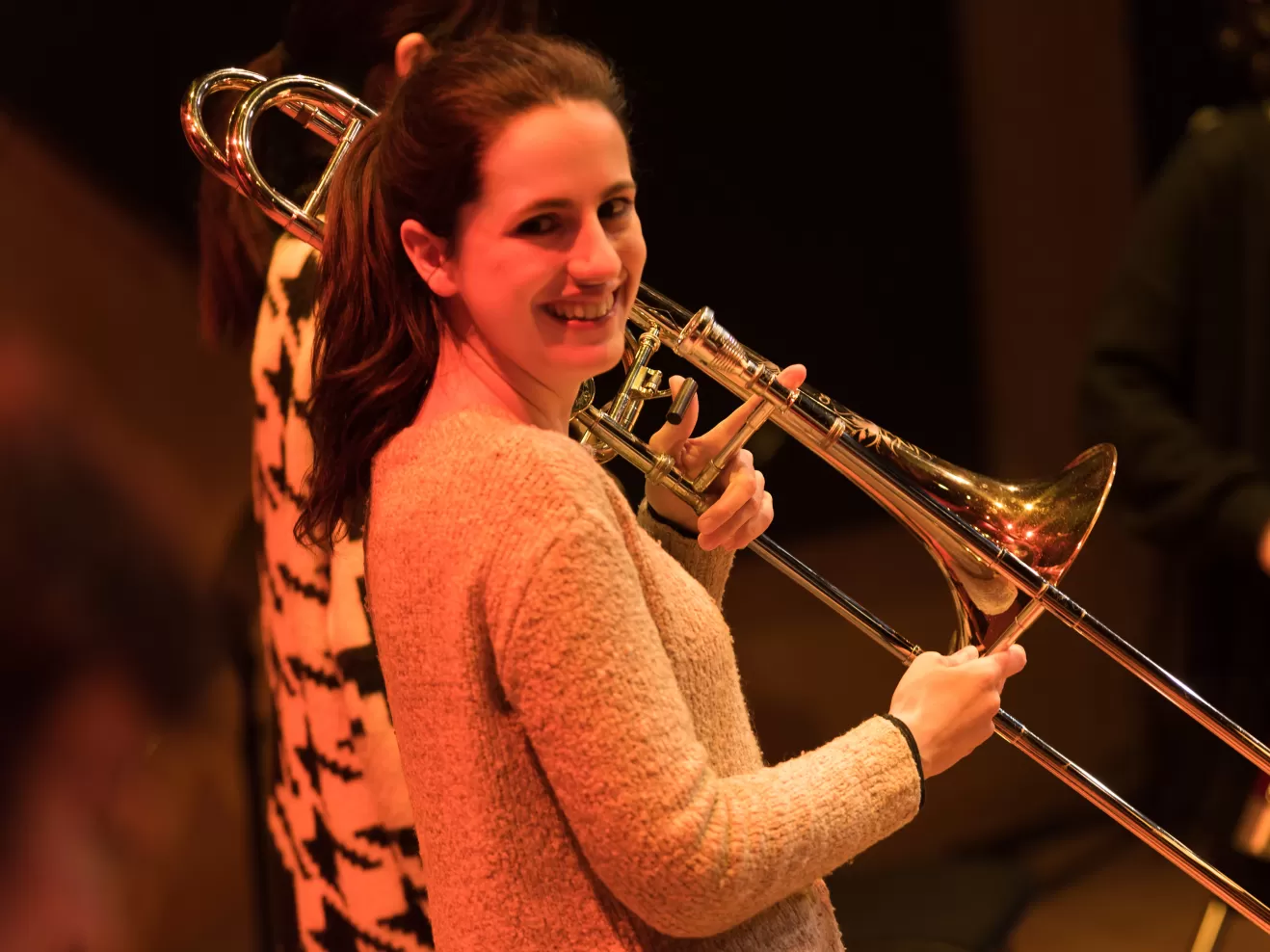
Axel Schlosser: That the students have the opportunity to work with us and that we don't just teach in a closet, but pass on our knowledge, our experience directly to them. This has, in a positive sense, something of an apprenticeship on top - in the sense of a craft apprenticeship. So far, there is simply no such cooperation, regardless of whether the students want to play instruments, write or conduct. We don't know yet who will be interested in the end, but we are very excited and hope for a real rush of good people. In any case, the interest in the band is quite high, meaning that everyone would like to participate and also teach. What is also unique for students is that they can get in touch with our guests, with international soloists, arrangers. That is a great bonus.
Ralph Abelein: You just talked about an apprenticeship. You do your apprenticeship, later you become a master, and then you do your master's degree. What do you learn in this apprenticeship - in very musical, concrete terms?
Axel Schlosser: What we do on the radio with the hr-Bigband could be described as the work of a studio musician who plays live. That means that all kinds of styles can come up, which of course we have to deliver at the highest level. Basically, people can learn flexibility. You have to be good at sight-reading, you have to be a first-class ensemble player, and you also have to be first-class as a soloist. And the requirements are complex: from 'How do I play a pop song?' to 'How do I move in almost freely improvised large orchestral material?'
Olaf Stötzler: In this way, the course of study corresponds exactly to what you encounter every day in your professional life as a jazz musician. If you are already close to it during your studies, as we are, by really participating and immersing yourself in the organic body of the band, then this is one of the best preparations for the profession that you can get. We record, we rehearse, we play concerts, we do whatever. That's a lot of facets, as Axel already mentioned: in different styles, in different situations - sometimes pure studio, sometimes concert, sometimes live on the radio, sometimes streamed.
Ralph Abelein: Students majoring in writing also come into direct contact with you, can realize their compositions and material with you for three studio days each semester.
Olaf Stötzler: One idea we have for the students in this focus, for example, is also: That they prepare for an assignment, just like in real life. We assign someone to work on the music of Miles Davis or Jelly Roll Morton or Steely Dan, for example. So we don't just tell students, come with your music, but give them a subject here. It can't just be about their own compositions; they also have to practice fulfilling such requirements.

Ralph Abelein: With the focus on leadership, there is a third focal point. Here, we tend to focus on the broader spectrum of youth work. The big band as a body of sound has found a permanent place in schools, music schools, in the semi-professional sector, in youth work. How do you see the scene?
Axel Schlosser: I think the scene is both stable and growing, for factual reasons alone - in principle, you have a fixed lineup, you have good access to sheet music, and you can practice everything imaginable with the young people: sight-reading, good ensemble playing, good comping, good soling. There are many reasons why big bands are so popular and are becoming more and more popular at schools, and some of the student ensembles that we have experienced are really amazingly good, because people at the grassroots level are committed to them and are incredibly active.
Olaf Stötzler: Another aspect: almost all great jazz soloists started in a big band or went through this school. Miles Davis or John Coltrane, for example, or today Till Brönner. Big bands have always been institutions for learning the language of jazz, for exchanging ideas with others, and for entering into an artistic dialogue.
Ralph Abelein: Last but not least: Do you expect any impulses for the local jazz scene from the HfMDK and the course of studies?
Olaf Stötzler: I would like that. Ultimately, lively music scenes are also created where there are schools - that's certainly not the only factor, but it's an important one. We should manage to upgrade the Rhine-Main region in general and make it more attractive. There is a lively scene, there are also new clubs here in Frankfurt that are doing great work. Jazz Montez, for example, with all its many events, whether in the Atelierfrankfurt or in the Milchsackfabrik. If we seek solidarity with Mainz and think about the entire Rhine-Main region, including Wiesbaden and Darmstadt, it can only be good.
Axel Schlosser: I am also convinced of this. As a metropolitan region, Rhine-Main already has a lot to offer; the picture is just a little diffuse so far. But if you look at the big picture, there are plenty of opportunities to perform and try out new projects. And I think that the study program and the people who come here through it can help to upgrade the scene. As Olaf said: If everything grows together more into a Rhine-Main scene, that would be a really nice thing.